


Most books are about success. This one is about getting dramatically better at failure — because that’s where the real work happens.
There are thousands of books on how to succeed — and why not? Everyone wants to. Most will tell you the same story: fail, pick yourself up, and march toward inevitable triumph. The focus, as always, is on the success. But here’s the uncomfortable truth: in your career, you will spend far more time failing than succeeding.
This article isn’t about avoiding failure. It’s about getting dramatically better at it — to Fail Faster and Fail Better. Master this, and the successes will follow naturally.
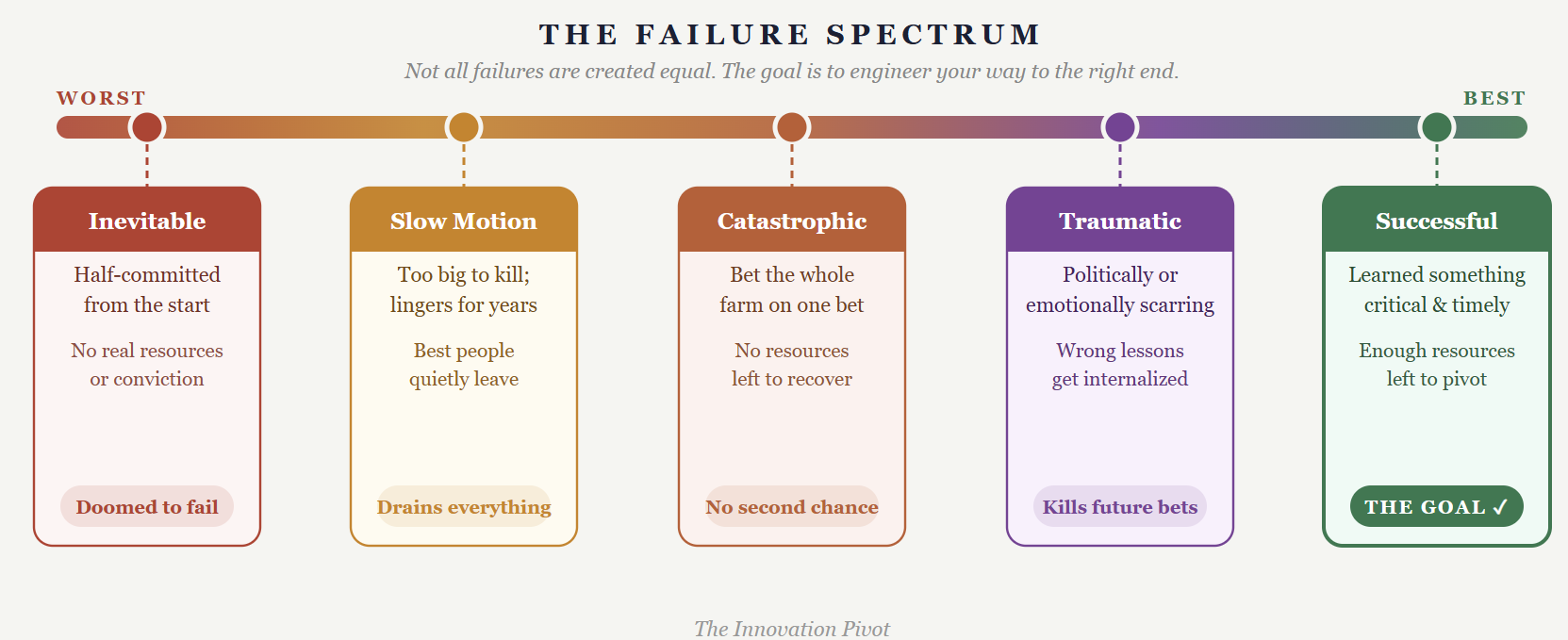
The Five Types of Failure
1. Inevitable Failures
These are the failures you can see coming from a mile away. They happen when a team isn’t truly committed, resources aren’t properly allocated, or the effort was doomed from the start. No one is fully in — so no one is surprised when it collapses. These are the easiest to prevent: simply don’t start what you won’t finish.
2. Slow Motion Failures
The most insidious kind. No one pulls the plug because the project is “too big to fail” or too politically sensitive to kill. Meanwhile, your best people sense the writing on the wall and quietly start leaving. By the time it’s officially dead, you’ve lost more than the project — you’ve lost months of runway, your best talent, and your team’s morale.
3. Catastrophic Failures
You bet the farm. The project fails, and now there’s nothing left to try again. These are often born from overconfidence and under-planning — a single concentrated bet instead of a diversified portfolio of experiments. The project’s failure becomes the company’s failure.
4. Traumatic Failures
Politically damaging, personally devastating. The company might have been able to pivot — the resources were there, the market was real — but the people who led the charge lost faith in themselves, in leadership, or in the opportunity. Worse, the wrong lesson gets learned: “there is no product here” instead of “that was the wrong product.” Sometimes a competitor swoops in, absorbs your learnings, and builds the very product you failed to. You did the hard work; they got the win.
5. Successful Failures
The gold standard. You learned something critical. You failed in a timely manner. You still have enough resources to try again. This is the failure that leads directly to an innovation pivot — and it doesn’t happen by accident.
To be an excellent fail-er — not a failure — you must engineer your organization to land on the right side of this spectrum, every time.**
Building a Culture of Successful Failure
Successful failures don’t happen by luck. They are the product of deliberate organizational practices. Here are three strategies to build into the fabric of how your team works.
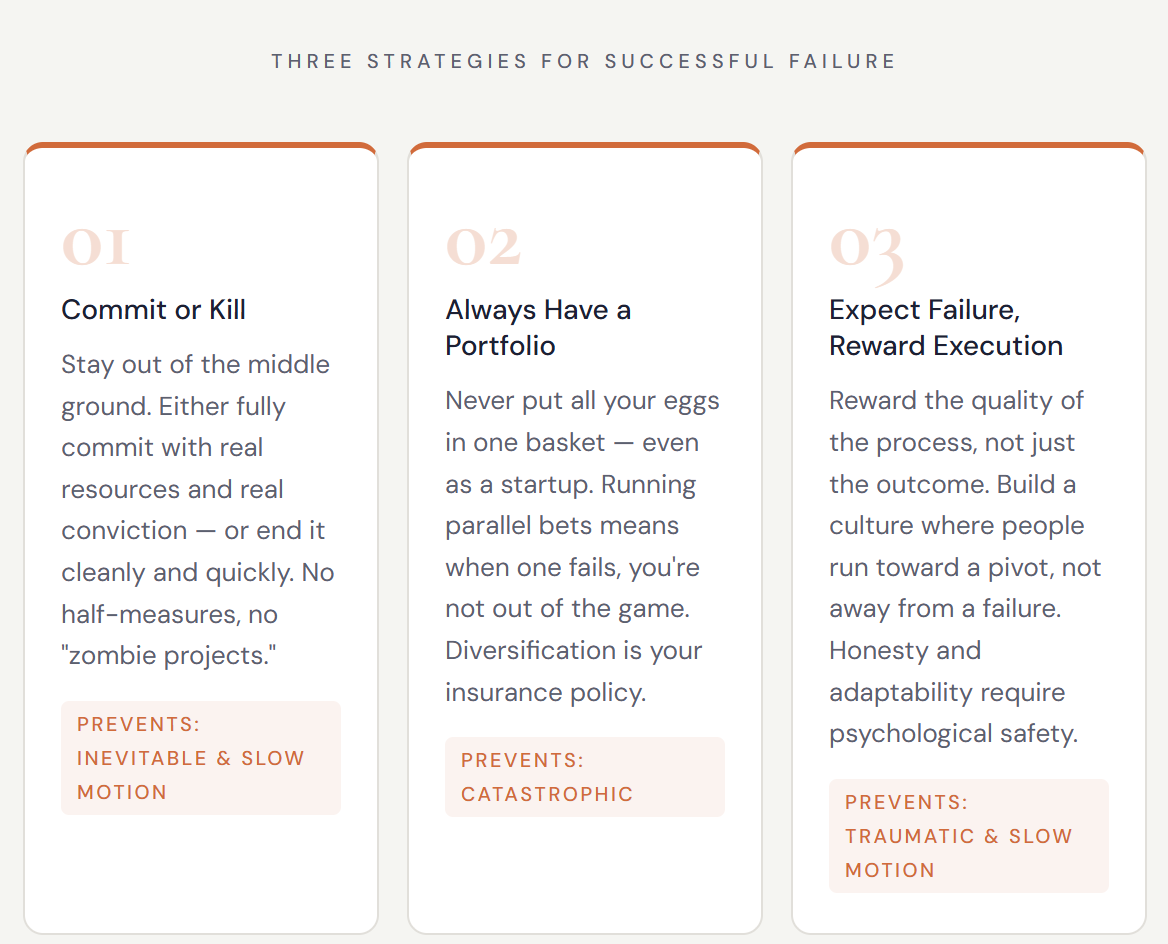
Strategy 1 — Commit or Kill
In tennis, no man’s land is the worst place to be caught — too far from the net to volley, too far from the baseline to defend. The same applies in business. Half-hearted efforts burn resources without generating real learning. The discipline to kill a project quickly is every bit as important as the courage to launch one boldly.
Prevents: Inevitable & Slow Motion failures.
Strategy 2 — Always Have a Portfolio
This applies even if you’re a startup with limited resources. A portfolio doesn’t have to mean ten simultaneous bets — it might mean two or three parallel hypotheses you’re stress-testing. When one fails (and one will), you’re not left with nothing. You still have options, learnings, and momentum.
Prevents: Catastrophic failures.
Strategy 3 — Expect Failure, Reward Execution
This is the culture shift that ties everything together. When failure is expected as a natural part of the innovation process, people stop hiding bad news. They stay honest, stay engaged, and stay ready to adapt. The difference between a traumatic failure and a successful one often comes down to whether the team felt safe enough to raise their hand and say, “This isn’t working” — before it was too late to course-correct.
Prevents: Traumatic & Slow Motion failures.
Get Great at Failing
It’s inevitable that you will experience failure. Don’t just accept it grudgingly. Embrace it strategically. Build an organization that fails fast, fails smart, and learns voraciously — and those successful failures will pave the way to your greatest successes.
well said. I like how you break it down.